This picture is called "Voyager's Neptune" and it shows the spacecraft Voyager 2's closest approach to Neptune on August 25, 1989. Voyager 2 has been the only spacecraft to visit Neptune, the most distant gas giant. In this composite image, you can see the glow of the outer planet, its largest moon Triton, and the planet's rings faintly surrounding it. Neptune's south pole is circled by a dark band and cirrus clouds in a cloudy vortex. The background starfield spans seven and a half degrees and is centered on the constellation Camelopardalis.
Astronomy & Stargazing
Friday, May 16, 2014
Wednesday, May 14, 2014
Astronomer Biography
Allan Sandage
Allan Sandage was born on June 18, 1926. He was an American
astronomer, best known for his work with Edwin Hubble.
In
1948, Sandage graduated from the University of Illinois, and went on to receive
a PhD from the California Institute of Technology in 1953, with astronomer
Walter Baade as his mentor. Sandage worked as an assistant to cosmologist Edwin
Hubble, and continued his research after Hubble’s death in 1953. In 1952,
Sandage proved both prestigious astronomers to be mistaken in a study of
Cepheid variable stars, showing that the brightest stars in galaxies were of
approximately equal inherent intensity, and that Baade was mistaken in the case
of H II regions which he found not to be stars and inherently brighter than the
brightest stars in distant galaxies. Sandage then calculated the age of the
universe to be approximately 5 and a half billion years, which was an increase
of a factor of 1.5 from what was previously calculated.
Allan
Sandage then began working at the Palomar Observatory, and in 1958 published
the first good estimate for the Hubble constant. He edited Hubble’s previous
value of 250 km/s/Mpc to 75, which is close to the current accepted value. Sandage
also did studies on globular clusters, calculating their age to be around 25
billion years. This calculation led him to think that the universe did not only
expand, but it expanded and contracted at a period of 80 billion years. He
co-wrote a paper with Donald Lynden-Bell and Olin J. Eggen during his studies
on the formation of galaxies in the early universe. Sandage discovered jets
erupting from the core of the M82 galaxy, likely caused by massive explosions
in the core, and is noted for this discovery. In 1959, Sandage married fellow
astronomer Mary Connelley. They had two sons.
During his career, Sandage
published over five hundred papers. He won many awards over the course of his
career for his work in astronomy, including the notable Bruce Medal in 1975. A
main-belt asteroid was named after him, 9963 Sandage. He actively researched at
the Carnegie Observatory until his death in 2010, at age 84.
Monday, May 12, 2014
APOD 4.7
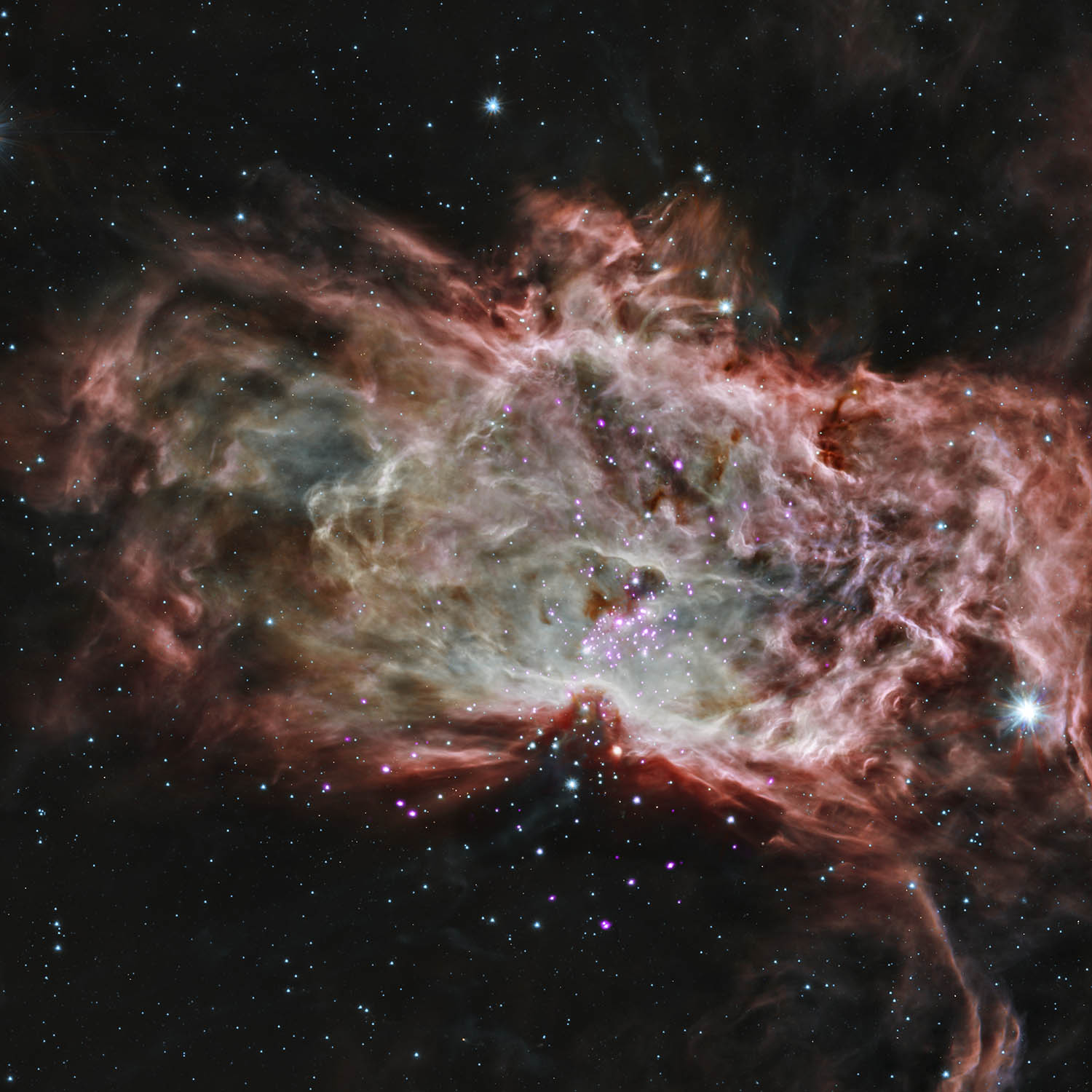
This picture is called "Inside the Flame Nebula" and it is a combination of X-ray data from the Chandra Observatory and infrared images from the Spitzer Space telescope. The Flame Nebula is in the dusty, star-forming region in Orion's Belt, only 1,400 light years away. This particular image shows the recently formed, embedded cluster of NGC 2024, ranging in age from 200,00 to 1.5 million years old. This composite image spans about 15 light years across the nebula's center.
Thursday, May 1, 2014
APOD 4.6
I had to pick this photo because it reminded me of the partial solar eclipse I was so lucky to see a few months ago. This one, however, was taken in Adelaide, South Australia by photographer Andrew Wall. It is titled "A Partially Eclipsed Setting Sun." The Moon occults the Sun at the top right, making it look as though someone had taken a bite out of the Sun. Unfortunately, the only place where this annular eclipse was visible was in a small part of Antarctica.
Wednesday, April 30, 2014
Astronomer Biography Sources
Allan Sandage
1. Cooper, Keith. "Allan Sandage, 1926-2010." Astronomy Now. N.p., 16 Nov. 2010. Web. 30 Apr. 2014. <http://www.astronomynow.com/news/n1011/16Sandage/>.
2. Ross, Dr. Hugh. "Reasons To Believe : Sandage Test Affirms Biblical Creation Model and Constant Laws of Physics." Reasons To Believe. N.p., 4 Mar. 2014. Web. 30 Apr. 2014. <http://www.reasons.org/articles/sandage-test-affirms-biblical-creation-model-and-constant-laws-of-physics>.
3. DeVorkin, David. "Allan R. Sandage (1926 - 2010)." American Astronomical Society, n.d. Web. 30 Apr. 2014. <http://aas.org/obituaries/allan-r-sandage-1926-2010>.
1. Cooper, Keith. "Allan Sandage, 1926-2010." Astronomy Now. N.p., 16 Nov. 2010. Web. 30 Apr. 2014. <http://www.astronomynow.com/news/n1011/16Sandage/>.
2. Ross, Dr. Hugh. "Reasons To Believe : Sandage Test Affirms Biblical Creation Model and Constant Laws of Physics." Reasons To Believe. N.p., 4 Mar. 2014. Web. 30 Apr. 2014. <http://www.reasons.org/articles/sandage-test-affirms-biblical-creation-model-and-constant-laws-of-physics>.
3. DeVorkin, David. "Allan R. Sandage (1926 - 2010)." American Astronomical Society, n.d. Web. 30 Apr. 2014. <http://aas.org/obituaries/allan-r-sandage-1926-2010>.
Monday, April 28, 2014
Observation!
There was a really great stargaze on Saturday night. We were able to see so many constellations, a couple satellites including the ISS, some M objects, and three planets through a telescope! Mars was very cooperative; we could even see the ice cap on it. Very cool. We then viewed Jupiter and its four Galilean moons, and Saturn. We saw the Sombrero Galaxy through the telescope as well-- very small, but just amazing when you think about how far away it is. It was a really fun stargaze, and I hope we'll be able to squeeze in another this year. :)
Friday, April 25, 2014
APOD 4.5
This picture is called "Massive Nearby Spiral Galaxy NGC 2841" and it shows just that. This jaw-dropping image shows a galaxy found in the constellation Ursa Major; even larger than our own Milky Way with a diameter of over 150,000 light years. It is 46 million light years away. In this "island universe" (a term for spiral galaxies like our own), you can see young blue star clusters and pink star-forming regions embedded in the dust galactic disk. The spiral arms of this galaxy are very tightly-wound. According to hubblesite.org, this image was taken in 2010 through four different filters on Hubble's Wide Field Camera 3. Wavelengths range from ultraviolet light through visible light to near-infrared light.
Subscribe to:
Posts (Atom)